
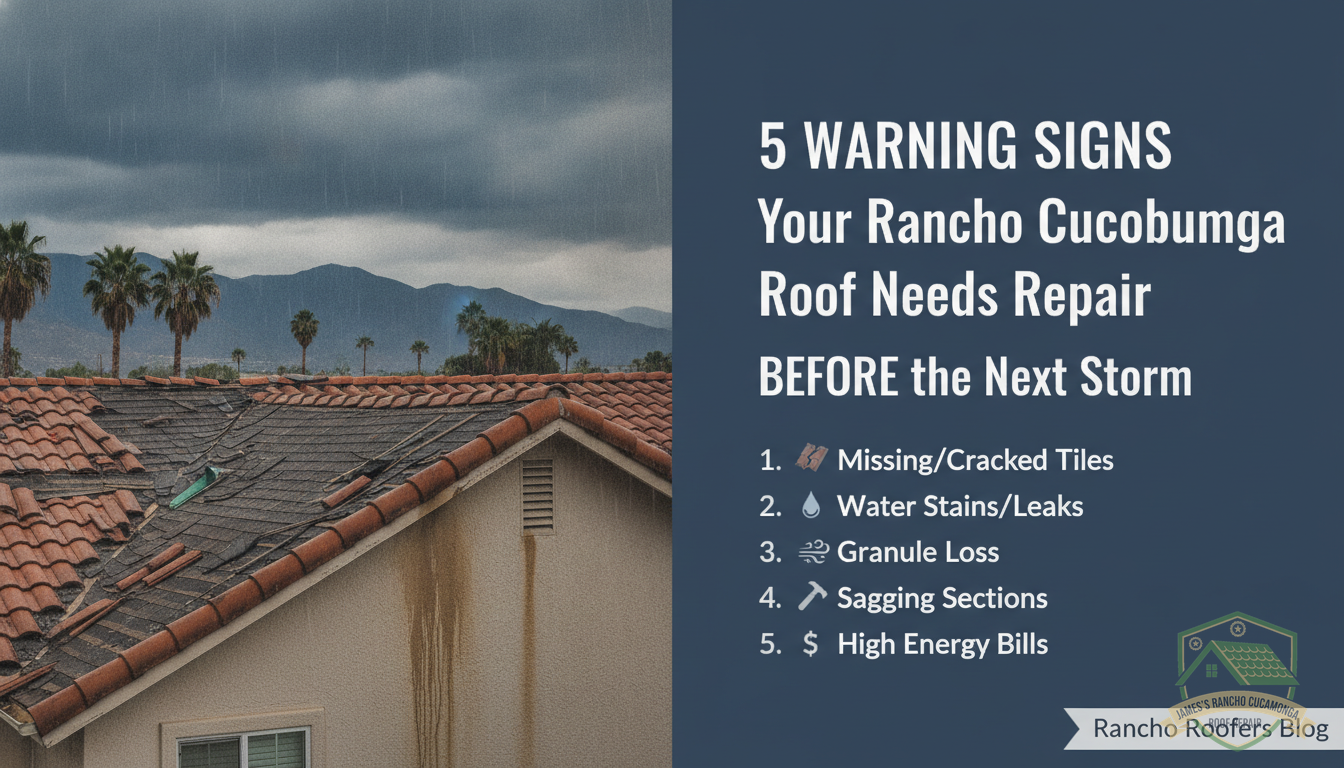
Don't Wait for a Leak to Take Your Roof Seriously
Southern California's weather can feel mild for months on end, which makes it easy to forget that your roof takes a beating from intense UV exposure, Santa Ana wind events, and the occasional powerful rainstorm. By the time water is dripping through your ceiling, the damage is already serious — and the repair bill is likely larger than it would have been if the problem had been caught early.
At James's Rancho Cucamonga Roof Repair, we inspect hundreds of roofs across the Inland Empire every year, and we consistently see the same warning signs that homeowners overlooked until something went wrong. Here are the five most important signals that your roof needs professional attention right now.
1. Curling, Cracking, or Missing Shingles
Asphalt shingles typically show their age through curling edges (called cupping or clawing) and surface cracking. Curling occurs when the shingle's bottom layer absorbs moisture unevenly, while clawing happens when the top layer shrinks faster than the bottom. Either condition leaves the underlying felt and decking vulnerable to water intrusion.
Missing shingles are even more urgent. A single missing shingle exposes bare decking to rain and can lead to rot within a single wet season. Santa Ana wind events — common in Rancho Cucamonga and nearby communities like Etiwanda and Alta Loma — are a frequent cause of shingle loss that homeowners often don't notice until they spot debris in the yard.
If you see any of these conditions, schedule a professional roof inspection before the next rain arrives. In many cases, early-stage shingle damage can be addressed with targeted roof leak repair rather than a full replacement.
2. Granule Loss in Your Gutters
Asphalt shingles are coated with mineral granules that protect the asphalt mat from UV degradation and provide fire resistance. Toward the end of a shingle's service life, those granules begin to shed — and they end up in your gutters and downspouts.
Check your gutters after a rainstorm. A small amount of granule shedding is normal for new shingles, but if you're seeing significant accumulation of sand-like material in a roof that's more than a few years old, the shingles are nearing the end of their protective life. Exposed asphalt mat deteriorates rapidly under Southern California's high UV index, accelerating your path toward leaks.
Widespread granule loss is one of the clearest indicators that it's time to evaluate a shingle roof replacement rather than continuing to invest in piecemeal repairs.
3. Water Stains on Ceilings or Walls
A brown or yellow ring-shaped stain on your ceiling is the calling card of an active or historic roof leak. The stain is left by minerals in the water as it evaporates after soaking into your drywall or plaster. The visible stain is almost never directly beneath the actual entry point — water travels along roof decking, rafters, and insulation before dripping down to the lowest point.
This is why a DIY approach of "looking where the ceiling is wet" rarely finds the real problem. Our technicians trace leaks back to their true source — often failed roof flashing around a chimney, skylight, or plumbing vent rather than a missing shingle. Misdiagnosing the source and patching the wrong spot is one of the most common reasons homeowners call us after another contractor's repair didn't hold.
4. Sagging or Uneven Roof Lines
A roof deck should be flat and even between rafters. If you notice a dip, sag, or wave in your roofline when viewed from the street or yard, it often signals that the OSB or plywood decking beneath the shingles has become saturated with moisture and begun to deteriorate. In more serious cases, it can indicate rafter damage.
This is not a "wait and see" situation. A sagging roof deck is a structural concern that will worsen with each rainfall. Homeowners in Upland, Ontario, and throughout the Inland Empire have called us after ignoring a subtle sag that eventually led to a partial roof collapse during a heavy downpour. The earlier this is addressed, the lower the repair cost.
5. Flashing That Is Rusted, Bent, or Pulling Away
Flashing is the thin metal or rubberized material that seals the joints where your roof meets vertical surfaces — chimneys, dormer walls, skylights, and plumbing vents. It is the single most common source of roof leaks in Southern California, yet it's almost invisible to a homeowner doing a casual visual check from the ground.
Signs of flashing failure include visible rust streaks running down from a chimney, daylight visible through the joint between a chimney and the roof, or caulking that has cracked and separated. When flashing fails, water has a direct path into your roof structure — and it typically follows that path every single time it rains.
Our roof flashing repair and replacement service addresses these failures at the source with properly installed mechanical flashing — not just a fresh bead of caulk over a deteriorated joint.
When In Doubt, Get a Professional Inspection
Many of these warning signs are subtle and easily missed by an untrained eye, especially from ground level. A professional roof inspection from James's Rancho Cucamonga Roof Repair gives you a complete, photographic assessment of every component of your roofing system — shingles, flashing, valleys, gutters, pipe boots, and attic ventilation — with a written report you can use for insurance or real estate purposes.
We serve homeowners throughout Rancho Cucamonga including Alta Loma, Etiwanda, and surrounding communities like Fontana and Montclair. Call us at +19095328328 or stop by 12365 Foothill Blvd, #106, Rancho Cucamonga, CA 91739. We're open Monday through Sunday
Confirm Availability
Call +19095328328 or fill out our online form for a free, no-obligation quote.
Request Free Quote